


Interested in Selling?
Request a valuation
Interested in Selling?
Request a valuationHunt & Roskell were among the most renowned silversmiths and jewellery makers in 19th century Britain. The company was originally founded by Paul Storr and began trading as Storr & Co. in 1819 after Storr left his previous workshop at Rundell, Bridge & Rundell. However, Storr & Co. became Storr & Mortimer after Storr partnered with John Mortimer in 1822. This duo steered the company to great success - they were awarded the Royal Warrant in 1822 and by the 1840s, they were one of the most important manufacturers of silverware.

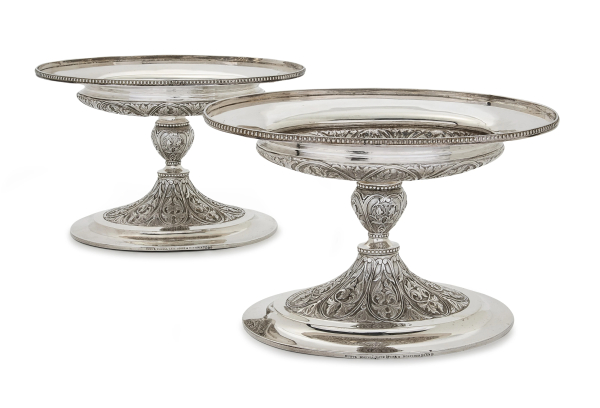
Lot 2: A pair of Victorian silver dessert stands. John Hunt & Robert Roskell, London, 1880
Estimate: £2,000 - £4,000
The company went through yet another change in 1838 after Storr retired and Mortimer partnered with John Samuel Hunt. Hunt (1785-1865), a talented silver chaser, was connected with Storr due to his marriage to one of Storr’s nieces and had worked with Storr at his Dean Street workshop for Rundell, Bridge & Rundell from around 1810. This made him an excellent candidate for partnership following Storr’s retirement. However, not long after this succession, Mortimer also retired (in 1843) and another partner was brought in; Robert Roskell (1800-1865), an acclaimed watchmaker. The company would then go on to continue under the name Hunt & Roskell until the late 19th century.

Lot 79: A large Victorian silver presentation goblet, London, c.1887, Robert Roskell, Alan Roskell, John Mortimer Hunt
Price Realised: £416 (March 2021)
Hunt & Roskell were, and still are, one of the most renowned partnerships of the Victorian era, creating masterful works that demonstrated the talents and tastes of the period. Some of the best designers and silversmiths of the time worked for the company, including the likes of Antoine Vechte (1800-1868) whom Hunt met in Paris in 1847. Hunt commissioned several pieces from Vechte, and by 1849 the designer was working exclusively for Hunt & Roskell (until 1862). Some of the last pieces Vechte worked on with Hunt & Roskell were the Breadalbane Vase Candelabrum and the Titan Vase which were both displayed at the 1862 International Exhibition.
On a visit to the Hunt & Roskell workshop in the mid-19th century, Henry Mayhew, a journalist and strong advocate of social reform noted: On reaching the spot we find it a modest and unpretending building; nor would one ever imagine, from its exterior appearance, what an amount and variety of work was carried on within its walls. But, be that as it may, there are, nevertheless, always eighty men employed on the works, and during very busy times as many as a hundred’. Mayhew’s observations illustrate the high demand for works by Hunt & Roskell in the 19th century, and strong auction results for silverware by this firm indicate that demand continues to endure to this day.
The other documented visitor to the workshop was a fifteen year old Beatrix Potter who visited with her family in 1881. The young Potter recalled the visit in her journal and meticulously detailed each step of her tour, highlighting the various stages of silversmithing, the many craftsmen working there, and the plethora of wealthy and respectable clients commissioning pieces from the company. Potter noted in her journal that in one of the final rooms on her tour here ‘there were some beautiful specimens of silver’, and amongst these she goes on to recount some of the specific pieces: ‘There was one large and very beautiful group of stags, which had been done for the Earl of Breadalbane, and another by a Russian artist which had been sent over to be made…One was engraving a beautiful cup for the Baroness Burdett-Coutts’. It’s evident from both of these accounts, the international acclaim the company had garnered, the demand for their work, and the status of the clients that they served.
Hunt & Roskell both went on to retire in the late 19th century and the company was subsequently acquired by J. W. Benson in 1889 continued trading as Hunt & Roskell Ltd. until the 1960s. However, works by the company, especially those from the Victorian era, are still highly sought after by collectors.
 Newsletter SignupKeyword Alerts

Would you like to receive personalised keyword alerts when new catalogues go live. If so, please indicate these below
Set a password to save your keyword alerts
Passwords are a minimum of 7 characters and must include an upper case letter, a lower case letter, a number and a special character (e.g., !@#$%^&*).


 Newsletter